Colored Stones
Aquamarine Jewelry: The March Birthstone Worth Knowing Well
The finest aquamarines carry a deep, saturated blue that rivals sapphire at a fraction of the price — but only if you know the difference between that stone and the watery, pale material that dominates commercial production.
Color: The Core Variable
Santa Maria vs. Commercial Grade and Everything Between
Aquamarine is a variety of beryl — the same mineral family as emerald and morganite — colored by iron. The resulting blue ranges from a pale, almost colorless tint that barely registers as blue, up through medium and dark saturated blues that hold their color at all viewing angles. The finest aquamarine color has a trade name that has stuck despite its specificity: Santa Maria, derived from the mine in Minas Gerais, Brazil where the benchmark material was found. Santa Maria aquamarine shows a deep, vivid blue without excessive gray or green that approaches the saturation of a fine blue sapphire.
The vast majority of aquamarine sold commercially is pale. It is clean, it is relatively affordable, and for buyers who want a large, clean blue stone with modest visual impact, it serves its purpose. But buyers who want color — saturated, commanding, genuinely blue color — need to understand that they are looking for a fraction of the production, and that fraction is priced accordingly. The distinction between a medium-light commercial-grade aquamarine and a deep Santa Maria-quality stone can be a factor of five to ten in price per carat at comparable clarity and size.
Clarity and the Beryl Advantage
Why Aquamarine Is One of the Cleaner Gemstones
Unlike emerald, which is structurally related but almost always heavily included, aquamarine grows in conditions that favor exceptional clarity. Eye-clean and even loupe-clean aquamarine is common in the commercial market, which means buyers can and should set a high clarity standard. An included aquamarine is not a sign of natural character the way an included emerald is — it is simply a stone with a flaw that could have been avoided.
The primary inclusion type in aquamarine is a parallel needle or “rain” pattern that can appear as a haze under certain lighting. This is typically identifiable in person and reduces both the value and the visual quality of the stone. Insist on a stone with no visible inclusions when viewed face-up under normal lighting. In most size ranges, finding one is not difficult, and settling for included material in aquamarine is unnecessary.
Heat Treatment and Its Prevalence
Understanding What the Trade Does Routinely
Heat treatment is standard in aquamarine, but it differs from the complex treatments applied to ruby and emerald. Most aquamarine rough has a blue-green or greenish cast, and gentle heating drives off the green component to produce a pure, stable blue. The treatment is permanent, improves the stone significantly, and is universally accepted without the price penalty applied to heat treatment in sapphire or ruby. A GIA report on aquamarine will note heat treatment as standard practice without any negative implication for value.
There are no major deceptive treatments in aquamarine to guard against at the level that glass filling affects ruby or oiling affects emerald. The main risk is simply misrepresentation of color quality, size-to-color relationships, or — more rarely — blue topaz sold as aquamarine. Blue topaz is not a lesser stone, but it is a different stone worth considerably less per carat. If you are making a significant purchase, a GIA identification report takes the guesswork out of species.
Size and Setting Strategy
Making the Most of an Aquamarine’s Visual Character
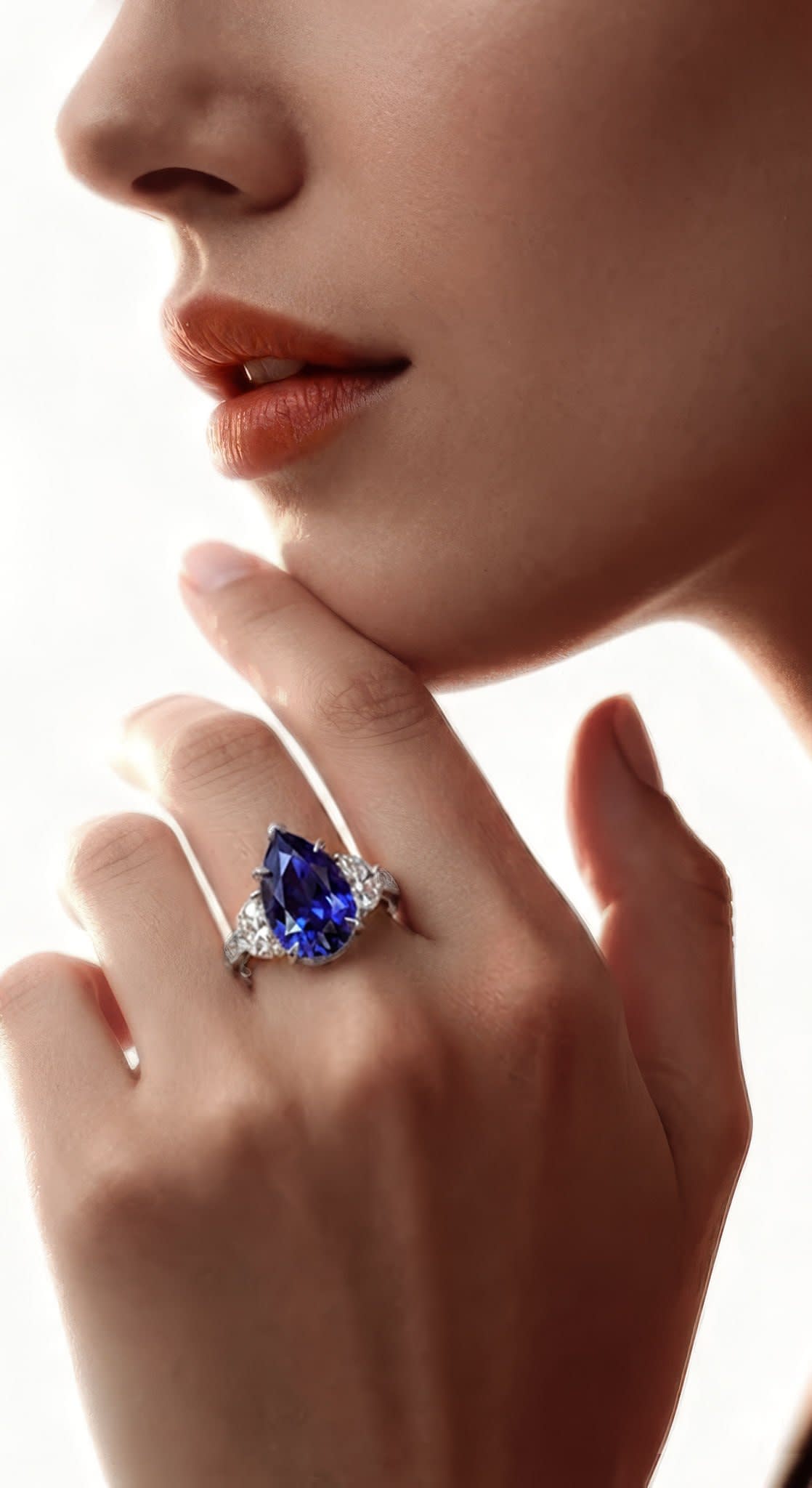
Aquamarine is one of the few gemstones that benefits meaningfully from larger sizes. The blue-to-saturation relationship in aquamarine is such that a small stone often looks quite pale while the same quality material at five or ten carats shows dramatically better color. Buyers who want to see the stone’s color potential should consider sizes they would not consider for ruby or sapphire. A four-carat aquamarine in a ring will show more color than a one-carat stone of equal quality by a significant margin.
The step cuts — emerald cut, Asscher cut, baguette — suit aquamarine particularly well. The gem’s clarity and the parallel faceting of step cuts create a mirror-like depth that plays to the stone’s glassy transparency. Brilliant cuts work too, but the step cut is the traditional and often superior choice for this material.
What People
Ask Us
How does aquamarine compare to blue sapphire in appearance? Fine aquamarine at its best can approach a fine blue sapphire in visual impact, but the two stones have distinct personalities. Aquamarine is more transparent and glassy, with a cooler, less velvety blue. Sapphire has more of a velvety depth and greater brilliance due to its higher refractive index. Side by side, an experienced eye distinguishes them immediately. For buyers who want the sapphire look at lower cost, a deeply saturated aquamarine is the closest alternative.
What carat size makes sense for a center stone? The minimum for meaningful color impact is around two carats. Most clients who want aquamarine as a center stone find that three to seven carats gives them the color presence they are looking for. Above ten carats, the finest material becomes competitive in price with mid-grade sapphire and the decision becomes more straightforward.
Is aquamarine durable enough for a daily-wear ring? Beryl has a hardness of 7.5 to 8 on the Mohs scale, which places it in a similar durability range to spinel and morganite. It is harder than tanzanite but softer than sapphire and ruby. Aquamarine is a reasonable choice for a ring that will be worn daily, provided the setting design protects the stone. Avoid settings with vulnerable thin prongs if the ring will be worn constantly.
What is the price range for fine aquamarine? Commercial pale aquamarine can be purchased for under $100 per carat. Strong medium-blue material runs $200 to $800 per carat depending on size and clarity. Deep Santa Maria quality above three carats with top color can reach $1,500 to $3,000 per carat. The color premium is real and visible.
Does aquamarine require any special care? Ultrasonic cleaning is generally safe for aquamarine, unlike emerald. Steam cleaning should be done with care given the difference in thermal expansion. The main care consideration is avoiding prolonged exposure to strong sunlight, which can cause color fading in some beryl varieties over extended periods. Normal indoor and occasional outdoor wear does not pose this risk in practical terms.
Continue Reading
Explore the Bez Ambar colored stone collection.
Ready to start your own piece? Contact the studio for a private consultation.
Commission a Piece of Your Own
Every piece is designed and made in the Los Angeles atelier, from the first reading of the stone to the final pass of the setting wheel. Enquire to begin a commission.


