Earrings
Choosing Your Diamond Earrings Studs
Diamond studs are the one piece that works with everything and ages well with you. The question is not whether to own a pair, but which pair will serve you best across decades of wear.
Every jeweler has a client who comes in saying she wants a pair of studs, and after twenty minutes it becomes clear she has been postponing this purchase for years because the options felt overwhelming. Shapes, sizes, settings, total carat weight versus face-up appearance. There is a right way to think through all of it, and it begins with understanding what a stud actually is: a single stone, held at the earlobe, with nothing to distract from it.
The Foundation of
Any Collection
Stud earrings have stayed at the center of fine jewelry for a reason that has nothing to do with trend. They work. They work with business clothes, with casual wear, with evening dress. They do not compete with other jewelry you are wearing. A woman with diamond studs at a boardroom meeting and the same woman wearing those studs at dinner on Friday night is correct at both occasions. No adjustment needed.
This is what jewelers mean when they call studs foundational. They are not necessarily the most dramatic piece you own, but they are the most reliable. Many collectors buy their studs once and wear them for thirty years.
Setting Choices
and What They Do
The setting is the first real decision. A prong setting lifts the stone away from the earlobe and allows light to enter from below, maximizing brilliance. Three prongs work well with round stones, exposing more of the diamond while holding it securely. Four prongs are standard for symmetrical shapes like princess, cushion, and Asscher cuts, where corner coverage matters.
A bezel setting wraps the stone in a continuous metal rim. It is the most protective option available, well suited to active wear or people who are hard on their jewelry. The tradeoff is a slight reduction in the light entering from the sides, though the clean, modern profile appeals to many clients regardless.
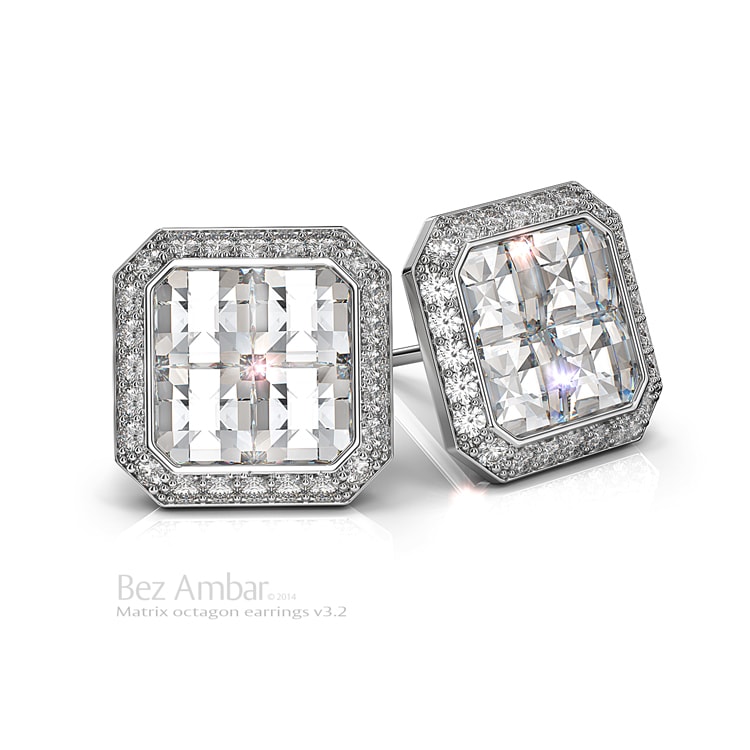
Then there is the framed stud. Bez Ambar’s Ring of Fire stud earrings place a center stone inside a complete frame of Blaze® cut diamonds, the same patented square-cut accent stones used in halo rings. The frame closes without gaps, so the center diamond and its surround read as a single, much larger gem. A 1.00-carat stud in a Blaze® frame can appear close to 2.00 carats face-up. For those who want presence without extreme carat weight, this is a worthwhile calculation.
Size and
Face Shape
Size is a practical and aesthetic question at once. The practical side: studs above 2.00 carats are heavy enough that some wearers feel them throughout the day. Post length, backing type, and stone weight all factor into comfort. An Omega back or screw back handles heavier studs better than a standard push back, keeping the stone upright rather than tilting forward.
The aesthetic side is less absolute than guides suggest. Elongated shapes, marquise, emerald, oval, tend to add visual length to rounder faces. Symmetrical shapes, round brilliants, princess cuts, square cornered stones, sit well on narrower faces. But face shape is one input, not a rule. Proportion is what actually determines whether a stud looks right: the stone’s diameter relative to the earlobe.
A useful check before buying: hold a ring of approximately the diameter you are considering against your earlobe. If it covers less than two-thirds of the lobe, it will look smaller than you expect in daily wear. If it extends past the lobe, it reads as a statement piece rather than a foundational one.
Matching and
Mismatched Pairs
The default for studs is a matched pair: identical stones, same shape, same setting, both ears. This is the classic approach and for good reason. The symmetry reads as intentional, and the stones need not be perfectly identical to look matched when the settings are the same.
The mismatched stud is a different idea entirely, one slightly larger stone, or two complementary shapes. Worn well, the mismatched approach has an ease that a precisely matched pair sometimes lacks. The risk is that it reads as accidental rather than deliberate. The key is contrast clear enough to be obviously intentional.
When to Invest
in Studs
With studs, there is no setting to hide behind. The stone is the piece. This makes quality more visible here than in almost any other jewelry category. An SI2 diamond that looks clean set into a ring may show inclusions under normal viewing distance when worn as a stud, because the viewer is looking directly at it in open light.
Eye-clean is the standard to hold for studs regardless of what the certificate says. The shape that delivers the most forgiveness is the round brilliant: its facet pattern disperses light in a way that masks small inclusions well. Cushion and princess cuts require more care in selection because their larger open facets are less forgiving.
Explore stud earrings or contact us to discuss your stone and setting options.
What People
Ask Us
Does carat weight or face-up size matter more for studs? Face-up size matters more in practice. Two diamonds with the same certified carat weight can look meaningfully different once set, depending on cut depth and proportion. A well-cut 0.90-carat round brilliant will look as large as or larger than a deep-cut 1.10-carat stone. When shopping for studs, ask to see stones set before making a decision.
What backing works best for heavier studs? For studs above 1.00 carat, a screw-back or locking backing is worth specifying. Added weight increases the chance of the earring rotating forward, pointing the stone downward. A locking mechanism keeps the stud upright throughout the day without constant adjustment.
Can a frame be added to an existing stud? In many cases, yes. Bez Ambar builds frames, including the Blaze® Ring of Fire design, around existing center stones. The feasibility depends on the stone’s shape and current setting architecture. Reach out with the details and we can assess.
What does total carat weight mean for stud earrings? Total carat weight, often listed as TCW, refers to the combined weight of all diamonds in the pair, both earrings together. A listing for “1.00 ct TCW studs” means each earring carries a 0.50-carat stone. Reading this carefully before purchasing saves significant disappointment.
Round or fancy shape for a first pair of studs? Round brilliant for most people. The round cut is the most efficient converter of light to brilliance, it suits every face shape, and a quality round stud holds its value better than most fancy shapes. Once you own round studs, a second pair in princess or cushion adds variety without overlap.
Commission a Piece of Your Own
Every piece is designed and made in the Los Angeles atelier, from the first reading of the stone to the final pass of the setting wheel. Enquire to begin a commission.


