Earrings
The Complete Guide to Diamond Hoop Earrings
Diamond hoops are the piece that bridges everything: formal and casual, day and evening, classic and contemporary. The right pair disappears into your life and improves every outfit you own.
Walk into any fine jewelry store and you will find diamond hoops in some form. Walk into most of them and you will find a narrowed version of the same idea: a thin tube of metal set with small round diamonds along the outside curve. The category is broader and more interesting than that. Understanding what separates a pair of diamond hoops that you reach for every day from a pair that stays in the drawer begins with a few structural questions.
Inside Versus
Outside Set Diamonds
The most important decision in a diamond hoop is not the size; it is where the diamonds sit. An outside-set hoop places diamonds along the outer curve of the tube, the part facing away from the ear. When the earring is worn, these diamonds face forward and downward. They are visible to the world, which is their intention, but they are less visible to the wearer in a mirror because the ear partially blocks the view from the front.
An inside-set hoop, sometimes called a half-inside or full-inside depending on the extent of the diamond coverage, places stones along the inner curve, the surface facing the neck. This arrangement produces a different kind of sparkle: the diamonds reflect against the skin and catch light from angles that outside stones do not. An inside-set hoop flashes when the head turns, creating movement and life that a static forward view does not show.
The decision between the two approaches depends on where and how you wear earrings. Outside-set hoops are more legible to others. Inside-set hoops are more alive in motion.
Diameter and
Gauge
Hoop earrings are measured by inner diameter, the distance across the inside of the circle. Small hoops, sometimes called huggies, run between 12mm and 20mm inner diameter. They sit close to the earlobe, offering a clean, unfussy look that suits everyday wear without reading as a statement. The huggie is a reliable workhorse: it goes with everything and never requires thought about whether it is appropriate.
Medium hoops, running from approximately 22mm to 35mm, are the most versatile format. Large enough to be visible and to frame the face, small enough to wear to work or a school pickup without looking overdressed. This is the size range that most people find they actually wear.
Large hoops, above 35mm, are statement pieces. They work at specific occasions and with specific looks. They are generally harder to wear daily, partly because of weight and partly because they require the rest of the outfit to accommodate them.
Gauge, the thickness of the tube itself, affects weight and proportion. A heavier gauge feels more substantial and reads as more luxurious, but adds weight to the ear over a long day. Lighter gauges are more comfortable for continuous wear.
Metal Choice
and Contrast
Yellow gold hoops have a warmth that flatters a wide range of skin tones and pairs naturally with the slight warmth of near-colorless diamonds. The metal is forgiving: a G or H color diamond, which might show a faint yellow tint against white metal, looks clean and intentional against yellow gold.
White gold and platinum both maximize the visual contrast between metal and diamonds. The diamonds appear whiter and more intense against a neutral metal background. This is the argument for white metal in diamond hoops: the stones do more work.
The practical difference between white gold and platinum is worth understanding. White gold is yellow gold alloyed with white metals and then rhodium-plated to achieve its color. The rhodium plating will wear over time, typically within one to three years of regular wear, at which point the piece needs replating to restore its color. Platinum is naturally white and does not require plating, though it does develop a surface patina over time that some people prefer to maintain polished and others leave as acquired character. Platinum is also denser and heavier than gold, which is a factor in earrings where weight translates to comfort over a long day.
Huggies Versus
Full Hoops
The huggie and the full hoop are both hoops in construction, a tube that passes through the ear piercing and closes, but they are different in character. The huggie is intimate and restrained. It hugs the earlobe, keeping its presence close to the face without projecting. The full hoop creates a circle that extends below the earlobe, framing it.
For those who want to wear diamond hoops daily without adjustment or thought, the huggie is often the right answer. It is comfortable to forget, secure, and appropriate across a wider range of situations. The full hoop, particularly at 25mm or above, makes itself known.
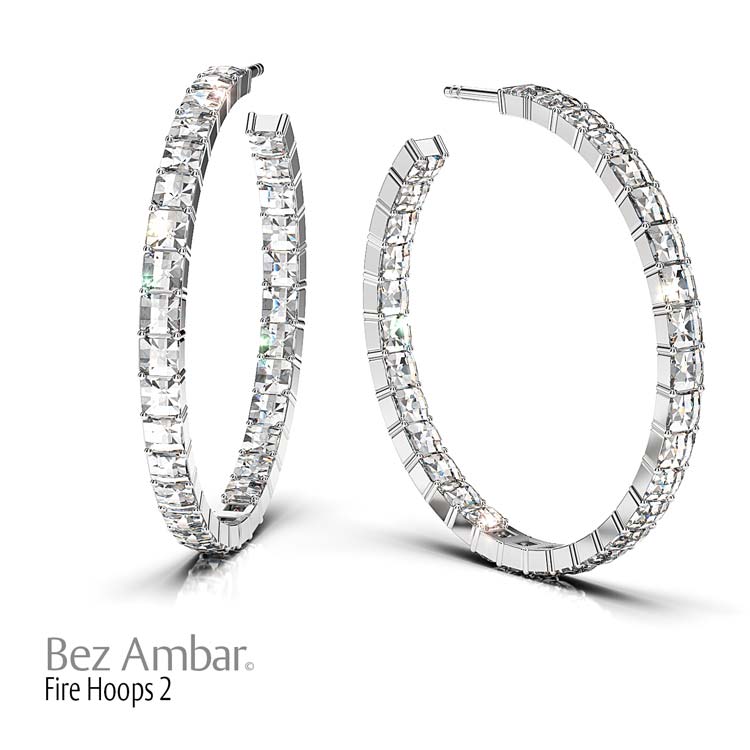
Bez Ambar’s hoop earrings incorporate the Blaze® cut accent stones in place of standard round brilliants, delivering a different quality of fire and color dispersion. Explore hoop earrings or contact us to discuss the right diameter and setting for your situation.
What People
Ask Us
What is the difference between inside-set and outside-set diamond hoops? Outside-set hoops place diamonds on the outer curve, facing forward. Inside-set hoops place diamonds on the inner curve, facing the neck and catching light from behind the ear as the head turns. Inside-set hoops tend to look more active in motion; outside-set hoops read more legibly in a photograph or a mirror. Many clients who wear hoops daily prefer inside or half-inside settings for their sense of movement.
What hoop diameter suits daily wear? For most people, a diameter between 22mm and 30mm inner diameter is the most wearable size for daily use. It is visible enough to register but not so large that it becomes a commitment. Huggies, at 12 to 20mm, are the easiest daily earring of all: they go on and do not require thought.
White gold or platinum for diamond hoops? Both maximize diamond contrast. Platinum is naturally white and does not need replating, but it is heavier, which matters for earrings. White gold is lighter but requires replating every one to three years as the rhodium coating wears. If weight is a concern, white gold is the practical choice. If you want to avoid maintenance, platinum is worth the additional cost.
How do Blaze® diamonds change the look of a hoop? Standard diamond hoops use round brilliant accent stones. Blaze® cut stones are square, with a facet arrangement that produces approximately ten times the color dispersion of a round brilliant. In a hoop, this means the diamonds flash spectral color rather than just white light, adding a quality of fire that is visible at normal conversational distance.
Can hoop earrings be worn with other earrings? Yes. A common approach is a huggie or small hoop in the first piercing and a stud in a second or third lobe piercing above it. The hoop anchors the ear and the stud adds point interest above. The proportions work best when the stud is smaller than the hoop, so the two pieces read as intentional rather than competing.
Commission a Piece of Your Own
Every piece is designed and made in the Los Angeles atelier, from the first reading of the stone to the final pass of the setting wheel. Enquire to begin a commission.


