Earrings
Pear Shaped Diamond Earrings: Why the Shape Works in Drops
The pear shape combines the pointed brilliance of a marquise with the rounded base of an oval — and the resulting silhouette, hung from a delicate connector, is one of the most elegant forms in earring design.
The Pear Shape’s Inherent Directionality
Why This Cut Was Made to Hang
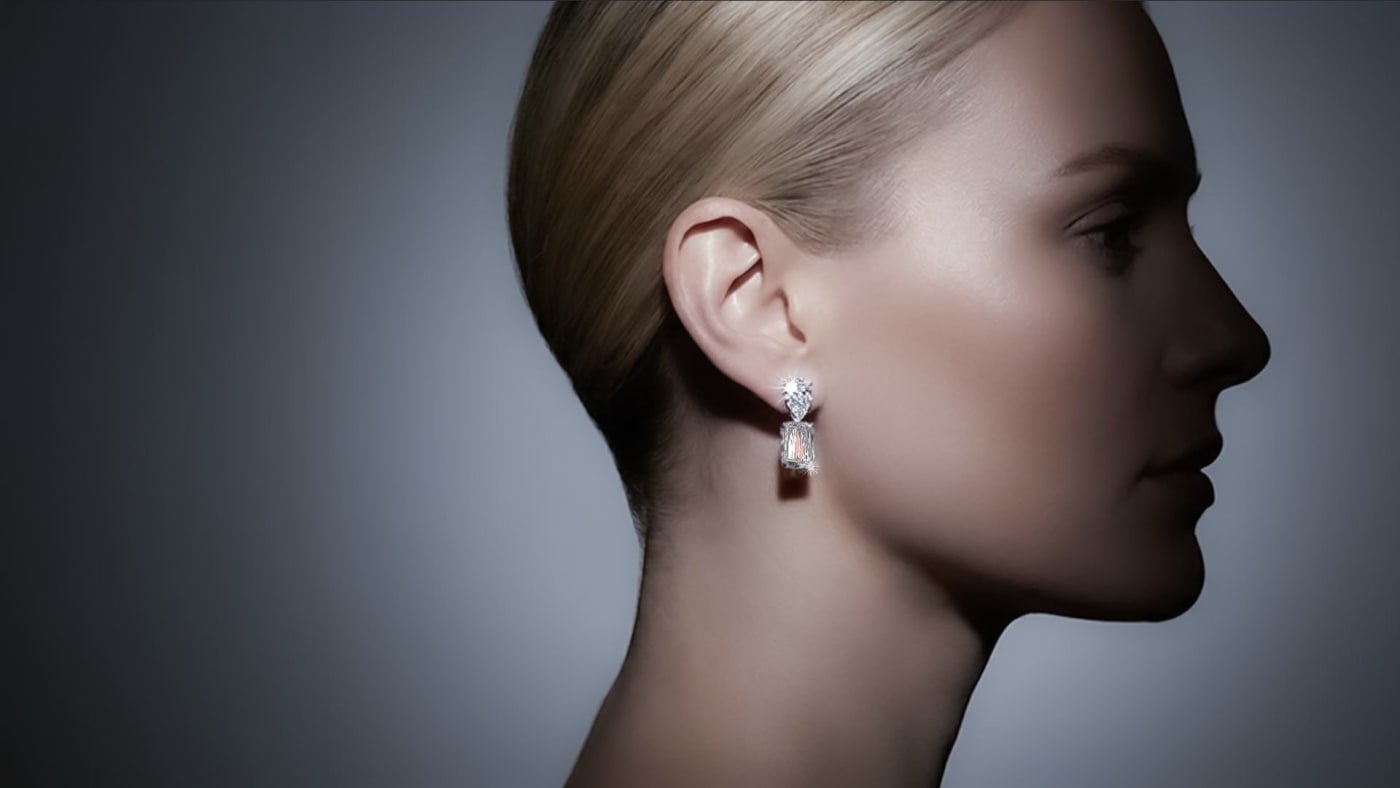
A pear-shaped diamond has an inherent vertical axis. The pointed tip and the rounded base create a teardrop form that implies direction — it wants to hang, point down, with the rounded base anchoring the visual weight at the bottom. Set in a ring, the orientation is a matter of convention and preference. Set in a drop earring, the pear finds its natural position. The narrow tip connects to the fitting above; the rounded base swells downward; the overall impression is one of graceful descent.
The pear cut itself is a modified brilliant — typically 56 to 58 facets, following the pattern of a round brilliant but adapted to the asymmetric teardrop form. The cutting challenge of the pear is producing even light return across the shape without a bow-tie effect — the dark zone across the width of the stone that poor pear cuts show prominently. A well-cut pear diamond has even scintillation from tip to base, with no dark shadow when viewed face-up. The bow-tie is the first thing an experienced buyer evaluates in any pear.
Length-to-Width Ratio and How It Reads in an Earring
The Proportional Decisions That Change Everything
The length-to-width ratio of a pear diamond determines how it reads visually in an earring setting. A narrow, elongated pear with a ratio of 1.7 to 1 or above creates a dramatically elongated teardrop silhouette that reads from across the room and emphasizes vertical length on the neck. A rounder pear closer to 1.4 or 1.5 to 1 looks more like a rounded teardrop and is less assertive. Neither is wrong — the right ratio depends on the intended length of the earring and the visual impression the design is meant to create.
For a shorter drop earring where the pear functions almost as a large stud, a rounder ratio reads better. For a long, dramatic evening earring where the pendant element needs to make a statement at the bottom of a chain or connector, an elongated pear is more effective. The design decision is about the total visual impression, not the stone in isolation.
Matching Pairs
The Challenge of Bilateral Symmetry
Earrings demand matched pairs in a way that is easy to state and difficult to achieve. Two pear diamonds of equal length, width, and depth — identical visual appearance from the front — are hard to source when the stones are significant in size. The variables that must match include not just carat weight but face-up appearance: color must match to within approximately one grade to look identical under room light; clarity should be comparable; cut quality determines scintillation pattern; and the two stones must appear the same size face-up, which is a function of spread rather than weight.
Professional matching of pear pairs for earrings above one carat each is a service that requires access to broader stone inventory than most single-jeweler operations can provide. At Bez Ambar, stones for matched pairs are sourced specifically for visual match, not just carat weight match. A pair where one stone is noticeably lighter in color or has a different pattern of light return from the other will look asymmetric in a way that undermines the earring.
Setting Options for Pear Drops
Prong, Bezel, and the Case for Each
The pointed tip of a pear diamond is a structurally vulnerable point that requires protection in the setting. A V-shaped prong that cradles the tip is the traditional solution — it holds the point securely while minimizing metal coverage at the most visually important part of the stone. The remaining prongs along the rounded base and shoulders hold the stone in its setting frame.
Bezel settings that encase the pear entirely are more protective but reduce the stone’s face-up appearance somewhat. A partial bezel or half-bezel that covers the tip and upper shoulders while leaving the belly of the pear open to light combines protection with visual openness. The choice depends on the design aesthetic and the intended use — a more protective setting for earrings that will be worn frequently and actively; a more open prong setting for formal occasional pieces.
What People
Ask Us
Does a pear diamond earring need to hang with the point down or up? By convention, the point hangs down. This orientation aligns with the natural visual reading of a teardrop shape — pointed at the base — and places the point, which is the most visually interesting part of the shape, at the lowermost position where the eye naturally lands. Some designers orient the pear point-up, creating a different visual effect where the rounded base is at the bottom. Both orientations are legitimate, but point-down is standard and most flattering in a pendant context.
How should I evaluate the bow-tie effect in a pear diamond? Look at the stone face-up under moderate lighting. A bow-tie is a dark shadow that extends across the width of the stone near the middle. A severe bow-tie occupies a significant portion of the stone’s face and is visually prominent. A slight bow-tie is nearly invisible and does not detract meaningfully. Any pear diamond should be evaluated in person rather than from a photograph, because the bow-tie only appears under certain lighting conditions that may not be captured in standard product photography.
What total carat weight makes a significant pear drop earring? For a statement fine pear drop earring, the pair should total at least 1.5 to 2.0 carats — meaning roughly 0.75 to 1.0 carat per ear. Below that threshold, the stones are small enough that the pear shape’s advantage over a round brilliant is reduced. For a dramatic formal piece, total weights of 3.0 to 5.0 carats (1.5 to 2.5 per ear) create a significant visual impression that reads across a room.
Can pear shaped earrings be made with colored stones instead of diamonds? Yes, and the pear shape works particularly well with colored stones in drop earrings. The elongated silhouette of a fine pear-cut sapphire, emerald, or tourmaline hanging from a diamond station is one of the classic formal earring designs. The color reading of a pendant stone is enhanced by the pear’s large face-up area relative to its carat weight.
Are pear shaped earrings suitable for everyday wear? The pear shape itself is not inherently unsuitable for daily wear. The practical considerations are the length of the pendant element — a long drop can catch on clothing or be uncomfortable during active use — and the security of the tip prong. A shorter pear drop in a protective setting with a lever-back closure is a reasonable daily earring. A very long, elaborate pear pendant earring is better reserved for formal occasions.
Continue Reading
- Princess Cut Diamond Earrings
- Rose Gold Diamond Earrings: A Metal That Earns Its Moment
- White Gold Diamond Hoop Earrings
Explore the Bez Ambar earring collection.
Ready to start your own piece? Contact the studio for a private consultation.
Commission a Piece of Your Own
Every piece is designed and made in the Los Angeles atelier, from the first reading of the stone to the final pass of the setting wheel. Enquire to begin a commission.


