Earrings
Oval Diamond Earrings: Length, Balance, and Setting Options
The oval is one of the most flattering shapes at the ear — it adds length to the face, catches light along its full extent, and delivers more spread per carat than the round brilliant.
Why the Oval Works at the Ear
The Shape’s Visual Advantages in an Earring Context
The oval modified brilliant has a length-to-width ratio that typically runs from 1.3 to 1.7, creating a silhouette that is directionally vertical when hung from the ear. This vertical elongation at the face is flattering for nearly every face shape — it adds perceived length to the jaw, draws the eye upward, and creates a lighter, more elongated visual impression than a round stone of comparable size would. These are the same reasons oval center stones have become dominant in engagement rings, and they apply with equal force in earrings.
The oval also offers what the trade calls “spread” — more face-up surface area per carat than a round brilliant of the same weight. This is because oval cut stones are often cut with slightly shallower pavilions than rounds, distributing more mass in the face-up plane. A one-carat oval often appears larger face-up than a one-carat round brilliant, which makes it effective as an earring stone where face-up visual presence matters more than the precise physical dimensions.
Cut Quality in Oval Diamonds
The Bow-Tie and How to Evaluate It
Oval diamonds share the bow-tie issue with all elongated fancy shapes — pear, marquise, and oval all show a dark shadow across the width of the stone when the pavilion facets in the center of the oval are angled such that they reflect the dark ceiling of the viewing environment rather than the ambient light sources. The bow-tie ranges from barely visible in well-cut stones to prominent and visually prominent in poorly cut ones.
Evaluating an oval diamond for earring use requires seeing it in person, viewing it from the face-up position under normal room lighting, and moving it slightly to assess how the bow-tie behaves under changing light angles. A slight bow-tie that disappears when the stone is tilted is different from a prominent dark shadow that persists regardless of lighting angle. For earrings specifically, where the stone hangs vertically and the viewer typically sees it from the front face-up position, the bow-tie assessment is the critical quality evaluation.
Stud vs. Drop Configuration
When to Use the Oval Each Way
Oval diamonds appear in earrings in two primary configurations. As a stud, the oval sits directly at the earlobe with the long axis running vertically — face-up, close to the ear. This is a classic form with a long history, and fine oval studs above one carat each are among the most recognized and desired pieces in serious fine jewelry. The stud configuration demands the highest cut quality because the stone is viewed up close, with no visual distractions around it.
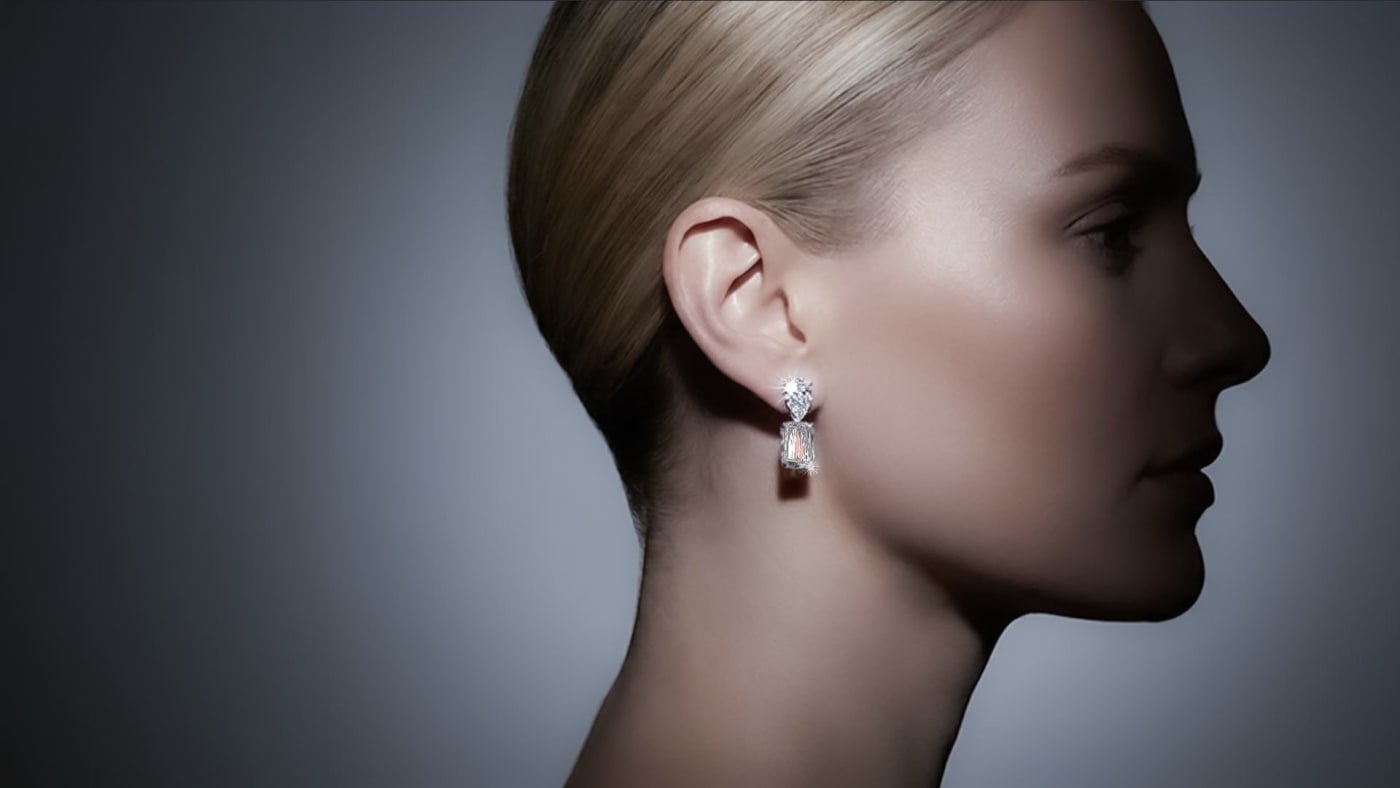
In a drop configuration, the oval pendant hangs from a connector element — a short diamond pavé link, a single station diamond, or a metal loop. The vertical orientation of the oval in the pendant position is natural and elegant. The drop configuration allows the shape to be seen in motion and at greater distance from the viewer, which changes the quality calculus somewhat: movement scintillation becomes more important than face-up clarity details.
Selecting Matched Ovals for Earrings
The Sourcing Challenge for Significant Pairs
The oval is a shape where slight differences in length-to-width ratio or cut depth are visible when two stones are side by side on the ears. Matching oval studs above one carat each requires sourcing stones that match not just in carat weight and color grade but in face-up silhouette, depth percentage, and the pattern of their scintillation. Two oval diamonds of identical carat weight but different ratios — one at 1.3 and one at 1.5 — will not look like a pair.
For significant oval stud purchases above one carat per stone, working with a jeweler who can source matched pairs rather than selecting individual stones from a standard inventory is worth the additional effort. The difference between a visually matched pair and two stones that are graded similarly but look slightly different in person is immediately apparent, and it affects both the wearability and the long-term satisfaction with the earrings.
What People
Ask Us
What length-to-width ratio is most flattering for oval earring studs? The range from 1.35 to 1.55 produces the most flattering balance at the ear for most wearers — elongated enough to read as distinctly oval rather than almost round, compact enough to not look excessively elongated as a stud. Ratios above 1.6 are better suited to pendant and drop configurations where the elongation reads as elegance rather than disproportion.
How large should oval diamond studs be for significant visual presence? The minimum for a clearly oval stud that reads distinctly from a normal social distance is approximately 0.75 carats per stone. Most clients seeking meaningful oval diamond studs end up at 1.0 to 2.0 carats per stone, which provides strong visual impact. Above 2.0 carats per stone, the weight and the price both escalate sharply.
What metal is best for oval diamond stud settings? Platinum is the traditional choice for fine diamond studs because it is durable, does not yellow over time, and its cool tone does not impart any warmth to the diamond’s apparent color. White gold is a common alternative that is less expensive. If the wearer’s other jewelry is yellow gold, matching metal makes practical sense. The metal choice for studs should be guided by lifestyle and existing jewelry rather than an aesthetic default.
Can oval diamonds be set horizontally in earrings? Yes, though it is less common. A horizontal oval stud — with the long axis running across the ear rather than vertically — creates a wider, more substantial visual impression that some designers use intentionally for a bold, architectural look. The conventional vertical orientation is more prevalent because it aligns with the natural direction of the ear and face, but horizontal settings are a legitimate and distinctive alternative.
Do oval diamonds show color differently than round brilliant cuts? Oval diamonds tend to concentrate color in the tips of the stone more than in the center, which means lower-color grades can look more yellowish in the points of an oval than they would in a round brilliant of the same grade. For ovals in earrings, going one grade higher in color than you would for a round is a conservative and worthwhile choice — particularly for the pointed variants of the shape where the color concentration is most visible.
Continue Reading
- Pear Shaped Diamond Earrings: Why the Shape Works in Drops
- Princess Cut Diamond Earrings
- Rose Gold Diamond Earrings: A Metal That Earns Its Moment
Explore the Bez Ambar earring collection.
Ready to start your own piece? Contact the studio for a private consultation.
Commission a Piece of Your Own
Every piece is designed and made in the Los Angeles atelier, from the first reading of the stone to the final pass of the setting wheel. Enquire to begin a commission.


